Why Recycled Polyester Samples Shrink (And The Tech Pack Fix)

When a recycled polyester (rPET) sample arrives from the factory distorted, warped, or missing two inches in body length, the defect rarely stems from bad raw flakes; it stems from unstated thermal parameters in the tech pack. Apparel brands using Genpire can reduce this production bottleneck by documenting clear finishing boundaries before knit rolls enter cut-and-sew lines. By defining stenter frame temperatures typically between 170°C and 210°C, assigning dwell times, and including ISO 3759 dimensional testing directly in initial factory documentation, product developers help lock in polymer chain memory and limit wash-triggered shrinkage before cutting the first garment sample.
The problem: the sample shrinkage surprise
A technical design team finishes a seasonal collection, submits initial measurements, and waits four weeks for a prototype. The physical sample lands on the fitting table, but the garment feels tight across the chest, the side seams twist forward, and the total length sits two sizes smaller than the approved graded spec. The factory claims they followed the pattern measurements exactly before laundering. The garment simply collapsed during the wash and steam press.
According to a technical specification guide on recycled polyester filament fabrics, rPET has accounted for roughly 15% of global polyester production in recent years. Despite this significant market presence, brands frequently specify recycled synthetics using the identical shorthand they applied to virgin petroleum-based goods for decades. Writing "100% Recycled Polyester" on a basic specification sheet assumes the fabric mill will treat the substrate with the thermal discipline it requires. That assumption can cost brands thousands of dollars in scrapped sample yards and weeks of delayed production runs, as shown in modern apparel turnaround benchmarks.
A basic spec sheet is not a production document. As detailed in the breakdown of what is a tech pack, factories require detailed bills of materials, graded measurements, and clear production notes to execute a garment properly. When a tech pack leaves out finishing tolerances, the factory will often default to their standard line speeds. In recycled textiles, running standard speeds without thermal controls increases the risk of dimensional failure.
Why it happens: the 15-second stenter frame window
Dimensional stability in synthetic textiles is determined mechanically and thermally rather than through moisture absorption alone. Natural fibers like cotton shrink because water swells the fiber diameter, forcing interlocking yarns to contract along their length. Synthetic fibers behave differently. Polyester is hydrophobic and absorbs negligible water. Its shrinkage occurs because internal stresses locked into the yarn during spinning and knitting have not been thermally stabilized.
The mechanics of heat-setting
Every knit fabric stores mechanical tension. Knitting needles pull yarn into tight loops, and fabric takedown rollers draw those loops into elongated, unnatural shapes. When the fabric encounters moisture and heat, those stretched loops relax into their natural equilibrium geometry. As explained in shrinkage testing studies, synthetic polymer chains must be brought above their glass transition temperature to release these internal stresses.
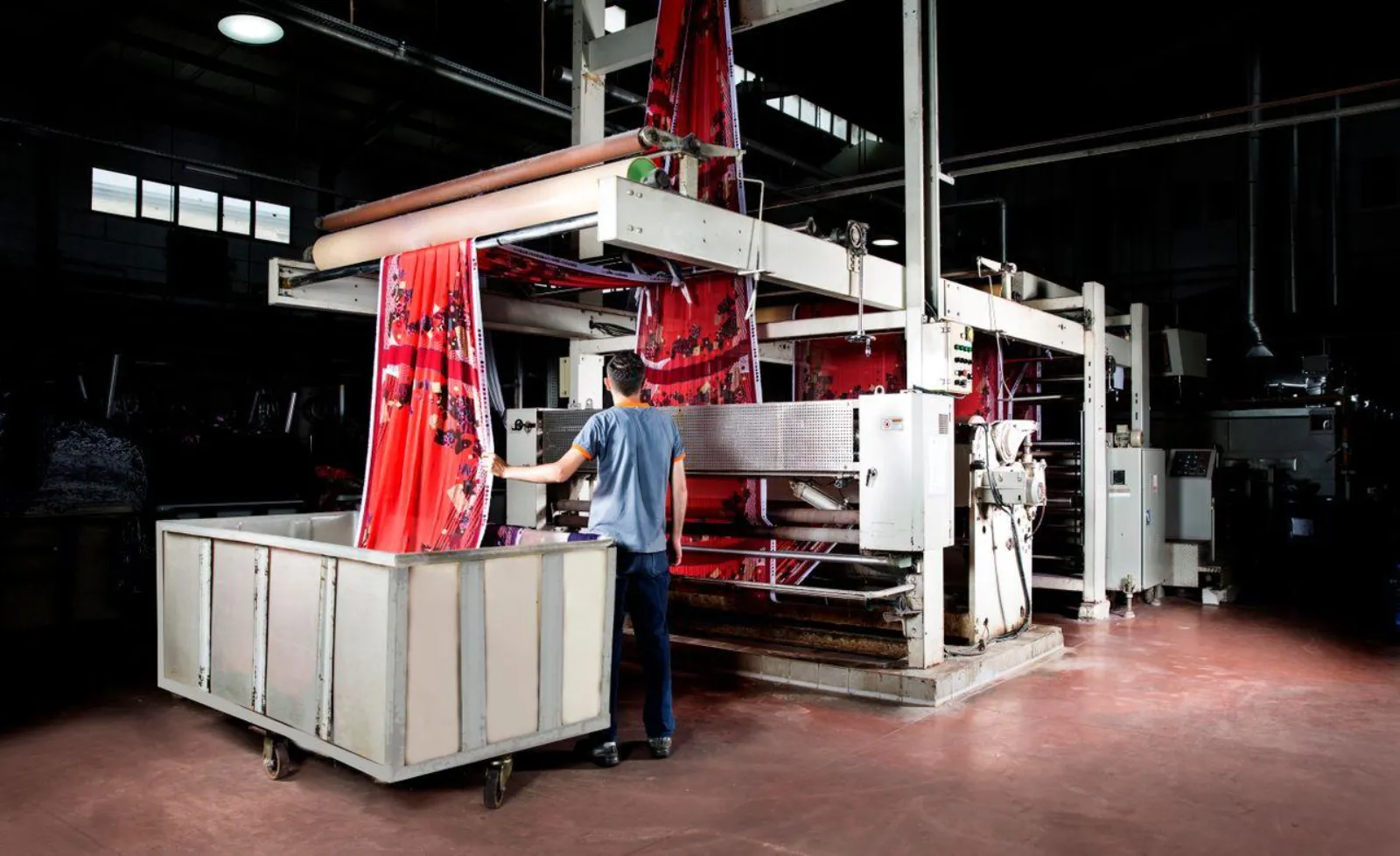
Mills achieve this relaxation inside a continuous heating machine called a stenter frame. The stenter grips the fabric edges with pins or clips, pulls the cloth to a controlled width, and conveys it through heated zones. Per industrial benchmarks on heat-setting polyester for dimensional stability, standard setting typically takes place within an exposure window of 15 to 50 seconds. During those seconds, heat allows tangled molecular chains to relax, rearrange, and recrystallize into a more stable state. If the stenter operator runs the line too fast to boost daily output, the core of the yarn may not reach the target temperature, leaving mechanical strain trapped inside the fabric.
Virgin vs. recycled thermal memory
Virgin polyester comes from a more homogenous chemical stream with similar polymer chain lengths and relatively predictable melting points. Mechanical recycled polyester, derived largely from post-consumer PET bottles, contains polymers with more diverse thermal histories. The resin has undergone previous heating, extrusion, washing, and mechanical re-granulation.
- Recycled polymers often feature wider variations in intrinsic viscosity than virgin chips.
- Previous thermal cycles can lower the exact threshold where molecular chains soften and deform.
- Trace moisture or chemical contaminants from past processing may interfere with recrystallization speed.
Because the thermal history of rPET can vary across resin lots, treating it like virgin fiber on the finishing line increases the chance of erratic shrinkage. The mill generally needs to give rPET sufficient dwell time on the stenter frame to help equalize these internal tensions. When a tech pack does not specify thermal stabilization requirements, the mill may run the fabric on the same accelerated schedule used for standard polyester, leaving the fabric more vulnerable to shrinkage the moment it hits an iron or a domestic dryer.
The solution: specifying thermal stability in your tech pack
To reduce sample shrinkage, remove guesswork from the dyeing and finishing stage. Factories produce the written parameters in production files. By embedding clear thermal finishing and testing protocols into Genpire tech packs, teams can establish a more consistent technical standard for the fabric mill.
| Processing Parameter | Virgin Polyester Spec | Recycled PET (rPET) |
|---|---|---|
| Stenter Temperature | 180°C – 190°C | 170°C – 210°C (typical) |
| Minimum Dwell Time | 15 – 30 seconds | 30 – 50 seconds |
| Mechanical Overfeed | +5% to +10% | +15% to +25% |
| Residual Shrinkage Limit | < 3% length and width | Target < 3% length and width |
| Primary Test Method | ISO 6330 / ISO 5077 | ISO 3759 / ISO 6330 |
Setting the 170°C to 210°C window
A tech pack's fabrication sheet should state a temperature envelope for finishing. For many rPET filaments and staple yarns, a stenter zone temperature held between 170°C and 210°C is commonly used. Heavier knits, such as 320 GSM fleece, often require the higher end of this range (around 200°C) with a longer dwell time of 40 to 50 seconds to help heat penetrate the yarn bundles. Lighter single jersey fabrics may run closer to 180°C to avoid scorching the fibers or degrading the handfeel. Exact settings can vary by mill and fabric construction.
Along with thermal setting, specify mechanical overfeed. As detailed in technical literature from Fersan Tekstil on compacting, fabric is typically fed into the setting and compacting zones faster than it is pulled away. An overfeed rate of +15% to +25% is often recommended for rPET. This mechanical overfeed allows loops to contract lengthwise in a controlled environment, encouraging relaxation before garment pieces are cut.
Mandating ISO shrinkage testing
Do not leave fabric evaluation solely to subjective inspection. Write explicit international testing standards into quality control notes. A complete testing callout should reference three consecutive procedures:
- ISO 3759: Specifies preparation, marking, and measuring of fabric swatches before washing.
- ISO 6330: Details standard domestic washing and drying procedures, specifying wash temperature (typically 40°C) and drying cycle (tumble dry normal).
- ISO 5077: Outlines the method for calculating dimensional change based on pre- and post-wash measurements.
Set a clear tolerance: residual shrinkage should not exceed 3% in length and 3% in width after three complete cycles as a target. State that the cut-and-sew line should not cut bulk yardage until the mill provides a laboratory test report meeting these numbers.
Updating the Bill of Materials
Move beyond generic descriptions in the Bill of Materials (BOM). Instead of listing "Recycled Poly," state the yarn structure, density, target finished weight, and heat-setting status. An example entry could read:
100% Post-Consumer Recycled Polyester, 75D/72F DTY, 180 GSM finished, circular interlock knit, pre-set and heat-compacted to ISO 5077 target < 3% residual shrinkage tolerance.
When a mill reads that level of detail, they recognize the client understands manufacturing requirements. It reduces the chance of the factory using scrap lots or rushing rolls through the finishing line.
When it is more serious: supplier red flags
Shrinkage is rarely an isolated defect. When a recycled polyester sample returns misshapen, it can point to broader issues in the mill's finishing line. Look for secondary defects across fit samples to diagnose deeper supply chain risks.
Uneven dye uptake
If a stenter frame operates with clogged hot-air nozzles or fluctuating burner temperatures across its width, the polymer may recrystallize unevenly. Areas exposed to higher temperatures can develop higher crystallinity, which rejects dye molecules. The result is barré: horizontal shaded bands or streaky variations across the garment body. If a sample shows both shrinkage along the hem and blotchy dye uptake under natural light, the mill may have failed to control stenter air distribution.
Failing standard wash tests
A garment that shrinks along the grain is problematic, but a garment that exhibits spirality is often unwearable. Spirality, or skewing, occurs when the wales and courses of a knit twist out of a 90-degree alignment.
- The side seam spirals around toward the front belly of the shirt after washing.
- Neckbands buckle or roll outward because the collar rib shrank at a different rate than the main body.
- Hem finishes cup upward due to differential tension across inner and outer coverstitch threads.
When spirality appears along with shrinkage, the mill may have skipped mechanical compacting. They relied mainly on surface tension to hold the garment shape. Reject the roll; pattern grading adjustments alone will not fix uncompacted, structurally twisted fabric.

Prevention: automating material-specific tolerances
Writing detailed engineering notes by hand for every style across a 40-piece collection creates human error. Designers may omit the dwell time on one style, copy-paste an outdated cotton spec onto a recycled fleece, or skip the testing standard notation.
This is where the Genpire AI Tech Pack Generator can restructure the pre-production workflow. When a garment style is designated as recycled polyester within the platform, the system pulls category-specific technical constraints and populates the manufacturing package.
Instead of searching for international testing codes, the system can map out:
- Suggested stenter dwell times and temperature boundaries suited to the chosen fabric weight.
- Point of measure (POM) tolerance charts matched to expected synthetic knit relaxation curves.
- Standardized testing mandates calling out ISO 3759, 6330, and 5077 for factory sign-off.
- Fully broken out BOM tables that convert basic prompts into mill-ready material entries.
By building technical parameters into the documentation from the beginning, the factory receives clearer technical specification. The garment sample they build is more likely to match the CAD measurements, surviving the steam table, the shipping container, and the customer's first wash.
Eliminating sampling guesswork
Sample failure is rarely a creative failure. In synthetic apparel, sample failure is often a documentation gap. When brands treat recycled polyester as an identical drop-in replacement for virgin materials without adjusting their paperwork, mills may cut corners on the stenter line to preserve their own margins. Specifying a 170°C to 210°C window, locking in a minimum 30-second dwell time where appropriate, and requiring third-party shrinkage verification before cutting gives teams greater control over the production floor. Protect product development margins, reduce unnecessary sample rounds, and create factory-ready documentation on the Genpire AI tech pack platform.
Document stenter temperatures, dwell times, and ISO shrinkage tests directly in your tech pack, before the first recycled polyester sample gets cut.
Related reading: what's inside an AI tech pack, the 14-point checklist before you send, and spec a sample you already have.